The following comments address some of the more common omissions, errors and misconceptions observed on Test #2
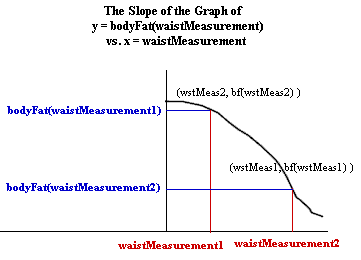
1. If the body fat percentage of a specific individual is a function bodyFat(waistCircumference), then the average slope of a graph of y = body fat percentage vs. x = waist circumference between x = waistCircumference1 and waistCircumference2 is
rise / run = change in y / change in x
= [ bodyFat(waistCircumference2) - bodyFat(waistCircumference1) ] / (waistCircumference2 -waistCircumference1).
This problem is an exercise in interpreting symbolic information. The solution should ideally be accompanied by a generic graph showing that bodyFat is represented on the y axis and waistCircumference on the x axis. The points (waistCircumference1, bodyFat(waistCircumference1)) and (waistCircumference2, bodyFat(waistCircumference2)) should be clearly labeled, the rise and run clearly indicated and the slope explained.
The graph is depicted below.
2. The explanation of the slope = slope form of the equation of a straight line with slope m passing through (x1,y1) should of course include the graph specified in previous instructions. It should also explain that if (x,y) is to lie on the graph, then the slope from (x,y) to (x1,y1) should be equal to the specified slope m. This if-then statement is essential to a full explanation.
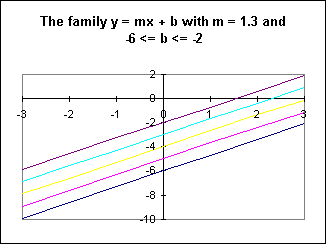
3. The instruction 'sketch the family of linear functions y = mx + b with slope 1.3 and -6 < b < -2' doesn't mean 'sketch the family of linear functions y = mx + b with slope 1.3, and also sketch the family -6 < b < -2'. If it meant that it would have said 'sketch the families ...'. The idea was to sketch the one family, where all lines have slope 1.3 and the y-intercept b ranges from -6 to -2.
.
4. When doing proportionalities, be sure to clearly identify x1, x2, y1 and y2, as well as the proportionality involved. For example, to compute the area of an object at a given diameter when the diameter and area of a geometrically similar object are given, we would generally let y stand for area and x for diameter, and we would usually let y2 and x2 stand for the area and diameter of the object whose area we wish to find.
In this case we note that the diameter ratio is (x2 / x1), so the area ratio will be (x2 / x1) ^ 2.
The area ratio is y2 / y1, so (y2 / y1) = (x2 / x1) ^ 2. Solving for y2 we get y2 = y1 (x2 / x1) ^ 2.
For example if we wish to find the area when the diameter is 15, knowing that the area is 80 when diameter is 10, the diameter ratio is 15/10 so the area ratio is (15/10) ^ 2 = 2.25. The new area will therefore be y2 = y1 (2.25) = 80(2.25) = 180.
5. Note that after finding the values for a difference equation, you were asked on the test to do a DERIVE fit to your results. For example if you obtained a(1) = 2, a(2) = 3, a(3) = 5, a(4) = 8 and a(5) = 12, you could use the first three values (where n = 1, 2 and 3) to obtain the data set [ [1,2], [2,3], [3,5] ] in #1 and then use fit( [n, an^2 + bn + c], #1) to fit a quadratic function to the data. Your results could then be compared with the predictions of the quadratic function for n = 4 and n = 5.
6. It's usually a whole lot faster, when given a graph of a straight line, to estimate m and b than to plug two points into y = mx + b and solve the resulting system for m and b.